Showing posts with label contamination. Show all posts

Monday, October 17, 2016

You can't always trust the label: Some products assumed to be non-gluten still contain gluten - New study

When shopping for products for your grain free or gluten free diet, stick to certified gluten free products. Even when the product does not have any obvious gluten in it like tahini, and you don't see the any worry some ingredients like rye or barley, a new study published September 14th in European Journal of Clinical Nutrition shows a fairly high rate of gluten contamination, .9% or almost one in ten have gluten in the amount ranging from 5-20 ppm of gluten. A product has to have less than 20 ppm to be certified gluten free. (So yes a product that is "gluten free" may have some gluten in it.)

Other studies have found gluten free cereals to have a 40% chance of having gluten in them. 

Here is an excerpt from Natural News writer Ethan A Huff :
Just because a food product doesn't contain wheat, rye, barley, or one of the other common gluten offenders as a labeled ingredient on the package doesn't necessarily mean that it's gluten-free. New research by a reputable gluten watchdog group found that many seemingly gluten-free foods actually contain trace amounts of gluten that could cause problems for people with Celiac disease or severe gluten intolerance.

The group "Gluten Free Watchdog" looked at 101 food products sold in the U.S. that fit the bill for not containing gluten ingredients, but that may or may not contain trace amounts of gluten from other sources. Some of these products contained advisory labels warning about possible cross-contamination with gluten, while others did not -- such labels are voluntarily, and not all food manufacturers use them.

Of the 101 products tested, 87 of them were not affixed with advisory labels, meaning customers who purchase them aren't being told that they may contain trace amounts of gluten. The good news is that most of them were, indeed, found to be clean and free of gluten. But 13 of the items, or 15 percent, tested positive for gluten, with nine of these containing gluten in amounts ranging from 5-20 ppm of gluten. Four of the items were found to contain at least 20 ppm of gluten.

On the flip side, of the 14 items that included allergy advisory statements -- these included cereals, spices, candy, baked goods, and tea and various other beverages -- only one tested positive for gluten. These and other findings were published in the September 14th online edition of the European Journal of Clinical Nutrition.

Read the rest of the article here; http://www.naturalnews.com/055587_gluten_labeling_food_allergens.html#ixzz4Midf6PKW


If you have Celiac disease or gluten sensitivity, stick with only verified gluten-free foods for your safety or better yet make all your own food, grain, dairy, sugar free and avoid processed foods which have other issues besides whether they have gluten in them or not.

To Your Health

Dr. Barbara (TM)
Celiacbrain (TM)


Friday, March 6, 2015

Cross Contamination of Unprocessed Grains and Legumes Starts in the Field: Answer for Linda

Red Wheat
I have an answer for Linda who asked:

My question is about cross-contamination. I have been purchasing my dry goods (seeds, dried fruit, lentils, etc.) from an organic foods distributor. Their packages have a warning on the label that says "May contain nuts, soy, sesame, wheat, mustard". I have not had an issue over the past several years, but the most recent package had what appeared to be 3 wheat kernels in it. Any recommendations? Most packages I've seen have those sorts of warnings - are there organic bulk items that guarantee no cross-contamination with gluten? Thanks.


Hulless Barley
My research tells me that it would be impossible to prevent contamination of seeds, grains, lentils or other beans, even organic, with wheat or other gluten containing grains such as barley. When I asked my office assistant, who has a degree in home economics, and has been homesteading for decades, she stated the same thing that the government says about contamination. 

Contamination can occur in any stage from planting, to harvesting, to transportation, storage and finally distribution to your house or store. Wheat kernels get stuck in the crevices and seams of the combine, in the augers and semi trailers which are used to harvest other crops. The kernels come loose spontaneously and mix in with the next crop being harvested.  I suspect the contamination rate is even higher if you were to buy grains: sorghum, millet.

Spelt
I did find a study that examined the rate of contamination of oats with gluten and barley, which should reflect the contamination rate of other grains. One research group analyzed a total of 134 oat samples, collected from Europe, the United States and Canada.This study confirmed that most oats were contaminated with gluten containing grains such as barley, wheat, and rye, mostly barley. (Hernando et al. Measurement of wheat gluten and barley hordeins in contaminated oats from Europe, the United States and Canada by Sandwich R5 ELISA. Eur J Gastroenterol Hepatol. 2008 Jun;20:545-54.). I don't recommend any ingestion of oats though because they contain toxic protamines, a subject I will cover in a future blog post.  

The way I see it is you are doing the best thing to protect yourself and your family from contamination with gluten containing grains, and that is to get the non grain dry goods in their unprocessed form and organic. And then make a quick inspection for other kernels like wheat, kamut,barley or spelt that may have found its way into the the package that you bought. And remove any offending kernels that you have found. 

Buying organic is important too because of an agricultural practice ( for the last 15 years or so) of "desiccation". Desiccation uses glyphosate to improve the drying time and allows for early harvesting of many grains and legumes. This practice is quite controversial and has been implicated with the increased incidence of celiac disease and 65 other diseases.
Non organic wheat is heavily contaminated with glyphosate as are beets, lentils, sugar cane and corn. 

Find out more about the future of agriculture here where Dr. Thierry Vrain discusses GMO's.

Thank you Linda, writing and sharing. And for working so hard to keep your family well.

To Your Health
Dr. Barbara


Monday, March 2, 2015

Eliminate "Gluten Free" Products and Recover Faster Than Those Who don't-The proof!


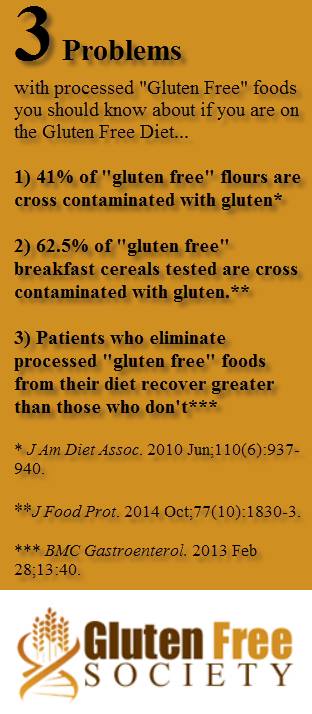
I can't recommend gluten free flours, cereals or products, even the ones labelled gluten free because I know the rate of contamination is so very high, and I know people don't get better unless they have a "true gluten free" as Dr. Osborne calls it, diet. 62.5% of gluten free cereals tested had greater than 20 mg/kg of gluten in them. Damaging amounts. Stop exposing yourself to the toxin, so your can follow up with healing.

To heal I recommend the doctor developed method called Gut and Psychology syndrome programme because it has 60 years of experience behind it, first as the specific carbohydrate diet. And because of its microbiome changing effects, which is being proven by science to be profoundly healing.


From Gluten Free Society:
More Evidence Against Processed “Gluten Free” Products

A new research study published in the Journal of Food Protection found more problems with “gluten free” products. The study looked at 78 product samples claiming to be gluten free. A summary of the study is listed below:

16 samples (20.5%) did contain gluten levels of ≥20 mg/kg, ranging from 20.3 to 60.3 mg/kg. In particular, five of eight breakfast cereal samples showed gluten contents higher than 20 mg/kg. These results may be of concern, as gluten sensitivity is known to vary among celiac disease patients.


Source: J Food Prot. 2014 Oct;77(10):1830-3.
Processed Gluten Free Products are a Potential Health Risk


What’s important to realize about this study is that the products tested were all supposed to be gluten free. 20.5% of them had enough gluten to be dangerous. 62.5% of the cereals tested contained gluten. If you are new to the gluten free diet, you most likely were told by your GI doctor or celiac support group to run out to the grocery story and start buying from the gluten free aisle.

Add this information to fact that a prior study done in 2010 showed that 41% of gluten free products tested positive for gluten.

When initially going gluten free, the average person reaches out to the gluten free aisle in the grocery store to find substitutes for pastas, breads, cereals, bagels, etc. The majority of these people seeking gluten free substitutes either remain sick or experience reduced improvement in inflammation. Some research studies show that the number is as high as 92% of patients fail to heal.

Most gluten free substitute products are made from corn, rice, and other grains (oats and sorghum) and pseudo grains (amaranth, buckwheat, quinoa). Unfortunately, these substitutes have been shown to cause damage for those with gluten sensitivity. Click the links below for some common examples:
Studies on corn gluten
Studies on certified gluten free oats
Studies on rice gluten
Studies on quinoa

Research has also shown that those following a processed gluten free diet can have a hard time healing. The study found that 81% of patients that were non responsive to a Traditional Gluten Free Diet responded to a TRUE gluten free diet (no processed foods and no grain substitutes).


I discussed much of this recently on Underground Wellness with Sean Croxton. You can listen in here <<<


To Your Health


Dr. Barbara