Friday, November 11, 2022

Celiac and Blurred Vision: Get Checked for Macular Degeneration

Thank you for reading my blog entries. I hope you find the information helpful. If you do, and if you haven't subscribed by the button on the right, I suggest you do subscribe as this will ensure you get the most recent entry automatically to your email address. I will post as often as I can. 

Celiac disease is an abnormal autoimmune disease of the connective tissues. It can be triggered any time and leads to damaged intestines and malabsorption. And over 200 medical conditions. 

The most difficult nutrients to absorb are fat soluble vitamins such as vitamin D, A, E and K. These vitamins can evaluated on testing and people with celiac commonly have low levels. Macular Degeneration has been shown in many peer reviewed research to respond to nutritional measures and to lifestyle changes. Especially to the addition to the diet of carotenoids such as lutein, and zeaxanthin: yellow fat soluble vitamins, and zinc.

Yellow absorbs blue light from our environment which is important as blue light damages the retina and reduces our ability to make melatonin (thereby interrupting good sleep). There is a high concentration of lutein and zeaxanthin in the macula of the eye which supply yellow to absorb blue light. What if one has poor absorption and poor concentrations of yellow lutein and zeaxanthin in the back of the eye. That may lead to blue light damaging the retina. And when part of the retina called the macula is damaged, there is the slow deterioration of ones central vision, the point where ones vision is most exact. Peripheral or side vision is spared, but one finds it more difficult to read, write, drive, and recognize faces. This damage might look like the deposit of drusens ( see below)  and this is called macular degeneration or sometimes referred to as ARMD.  


In the end, if you have tested positive for celiac disease or gluten sensitivity, change your diet to one  grain free, sugar free, legume free diet called GAPS, and take fat soluble vitamins and omega 3 high supplements. One may need the help of digestive enzymes as the pancreas ( also affect by the connective tissue issues) often can't make enough digestive enzymes to digest the food nor can the liver make enough bile. If in doubt get tested for markers of malnutrition, vitamin A, D, E and K levels and inflammation markers like CRP-HS. 

People with Celiac disease have higher risks of other risk factors for ARMD such as:
- higher risk of high homocysteine (from higher risk of having MTHFR variations, and low vitamin B12 from antibodies to the parietal cells of the stomach, so absorption is impaired, or low folate levels)
-higher rates of microvascular impairment and poorer circulation, in this case affecting the eyes. 
-higher rates of addiction such as smoking, and smoking is an added risk for the development of ARMD.
-higher rates of oxidative stress and free radicals because of higher rates of MTHFR variations which causes the formation of free radicals that damage.
-higher rates of inflammation from high omega 6/3 ratio (not getting and absorbing enough omega 3's), genetics, but also gluten ingestion whether by choice or accidental. Gluten free packaged foods have a higher rate of contamination, for example 40% of GF breakfast cereals are contaminated. I recommend a grain free diet. 


If you should find yourself having visual difficulties, don't wait!  Make an appointment to be  examined by a specialist in eye health. 

If you are interested in an introduction to Macular Degeneration, I found a good article written by Dr. Grossman at https://www.naturaleyecare.com/eye-conditions/macular-degeneration/
Here is an exerpt: 

Macular Degeneration (ARMD, or MD)

Blindness is not inevitable for people who have ARMD. There is a large amount of peer review research showing ARMD to be a nutritional and lifestyle responsive eye disease, meaning that you can stabilize and possibly even improve your vision with healthy lifestyle choices.
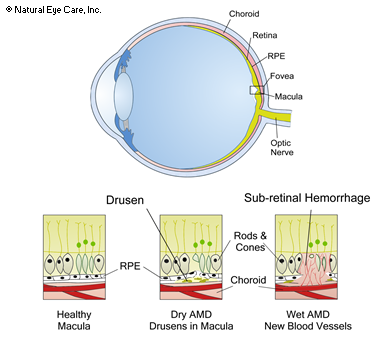
Most people with ARMD have dry macular degeneration. In dry macular degeneration tiny, yellow drusens develop. Drusens are accumulations of fatty, yellow material that form in the macula and people with ARMD have more and larger drusens than what is common with aging. They are thought to be comprised of waste proteins and lipids (oily material) that begin to accumulate due to poor circulation and waste-flushing in the eye. Antioxidants are important for the normal waste-clearing process. The drusen slowly crowd, distort, or break the cells in the macula leading to deterioration and resulting in blurred vision. Because drusen also include immune-system regulating molecules, it is thought that they are part of the immune system.3

The second type of macular degeneration is the "wet" form, (also known as choroidal neovascularization) in which new blood vessels begin to develop near the macula, causing fast and serious vision loss. Wet macular degeneration can result from progression of dry macular degeneration, left untreated, and affects about 10% of macular degeneration patients.

If AMD is found first in one eye, the other eye follows the same progression. This is because the nutrient deficiencies and other system-wide problems would exist in both eyes but manifest in one eye before the other..
...end of exerpt.

Read the whole article which covers: gender, prescription drugs linked to MD, Pathology, symptoms, causes, biochemistry and lifestyle issues. 

If you are diagnosed with macular degeneration, follow your specialists advise about lifestyle, protecting your eyes from harmful light waves and nutritional supplementation. There seems to be a roll to increase the microvascular circulation of the eye with herbs, acupuncture, laser, and microcurrent stimulation (as described in the book by Dr. Edward Kondrot). 

To your health
Dr. Barbara 


 This is thanks to Dr. Hertoghe on the subject of Longevity.

 Something to pay attention to if you are interested in healthy longevity.  Thank you for reading my blog. If you share the blog please mention that you can get the next new entry automatically to your email address if you subscribe. 

Are you ready to learn thought-provoking information?
 

| Did you know that men over 48 with high hostility are 10 times more likely to die, which can mean 30 years less life?

| Did you know that the two greatest factors that explain why some people become centenarians are positive psychological attitudes and a low-calorie diet?

| Did you know that by improving your emotions and your psychological attitudes you can live 10 to 20 years longer, while improving the diet 5 to 10 years longer? 

| Did you know that men reporting high levels of worry are twice as likely to have myocardial infarction and have 50% more risk of dying from myocardial infarction ?
 
| Did you know that without cortisol people die within 24 hours with severe hypoglycemia and a severe drop in blood pressure?
 

| Did you know that testosterone therapy and even more growth hormone therapy may help to substantially live longer?
 
| Did you know that estrogen therapy may help women with breast cancer live considerably longer?

| Did you know that maintaining optimal kidney function is a factor in long life?

Wednesday, March 20, 2019

Extra Virgin Olive Oil is among the most healthiest natural oils- Suzy Cohen

I believe extra virgin olive oil (EVOO) is among the most healthiest natural oils you can consume. There are so many benefits of EVOO. It has been shown to reduce the risk of cancer and of stroke. I don't recommend the use of vegetable oil, rapeseed oil, canola oil or even organic canola oil. I do recommend olive oil, grape seed, avocado, tea seed and pumpkin seed oil. I am also a fan of good quality butter. 

When it comes to buying EVOO though you do have to be a wise shopper because it is hard to find real, 100% EVOO. See my article on this subject here.

Buying pure EVOO is especially important if you are trying to follow a Mediterranean diet because much of the benefits of the Mediterranean diet is from the EVOO.

To find out more about the benefits of EVOO see this exerpt from Suzy Cohen's article:

Olive Oil Reduces Cancer and Risk of Stroke

Olives are something I’m fanatic about. I’ll eat any kind, any flavor, and time of day or night! I’m obsessed with them.

Olive oil is the liquid fat which comes from the olive tree. It is extremely high in oleic acid, which is known to reduce blood pressure. It also contains a good amount of natural vitamin E, carotenoids and oleuropein. That compound has strong anticancer and anti-inflammatory effects.

Olives are fruits, and both the fruit and the oil have medicinal benefits. The main active ingredient in olive oil is oleic acid, some phenols and squalene.


Extra virgin olive oil or EVOO is sometimes referred to as cold-pressed. This type of oil is higher quality, better flavor and lower acidity than plain olive oil. When you see “extra virgin” on the label, that means something good. It means that the oil was mechanically pressed out of the olives, as opposed to using a bunch of chemicals to extract it. When the oil is squeezed and pressed from the olives mechanically, the vitamins, amino acids and fatty acids are not destroyed.


As far as the phenols go, the main ones are hydroxytyrosol and oleuropein. I give you their names so you can look up all the medical(TM) research at pubmed, and see all the incredible studies that prove pharmacological value when it comes to activities. These include:

To find out what studies have shown about the links to improved health and longevity see the rest of the article here.  What I really like about EVOO is it's link to reducing the risk of cancer and stroke. 

To Your Health
Dr. Barbara (TM)
Celiacbrain.blogspot.com (TM)

Sunday, February 10, 2019

Can Blood Pressure Medicine cause Celiac Disease?

The evidence is mounting that certain BP meds do cause enteropathy. If on a blood pressure medicine one develops diarrhea, nausea, vomiting or weight loss you should be aware it may be "drug induced" celiac sprue. And by changing medicines, the problem may go away. 


Read Dr. Osborne's expose. 

To Your Health 
Dr. Barbara (TM)
CeliacBrain.blogspot.com (TM)

Thursday, December 20, 2018

Cold or flu? Top Ten Natural Anti- Viral Agents, Ontario Association of Naturopathic Doctors

Since people with gluten sensitivity and celiac disease are considered "immuno-compromised", meaning they get infections more easily than the next person, it is a good idea to have a few tricks and tools to get over an infection. 

The most common infections are viral, like colds and flu's.

Here is a report from the Ontario Association of Naturopathic Doctors on the top natural anti-viral agents. Use three or four of them at the same time to counter a cold or flu. And if you are not getting better or have worsening symptoms, see your doctor. 


Winter is the time of year when we seem to be particularly vulnerable to all kinds of illnesses that are caused by viruses including colds, flu and cold sores. A virus is not to be confused with bacteria, which causes infection. Viruses are tiny bits of nucleic acids that contain information and use your body’s cells to create more copies of themselves.

There are very few treatments, allopathic or natural that can kill a virus outright, as usually a virus must run its course. However the list of natural remedies here come as close to stopping a virus in its tracks as Mother Nature can get.

COLLOIDAL SILVER

Silver has been utilized as a medicine since ancient times to treat scores of ailments, including the bubonic plague.


To Your Health
Dr. Barbara (TM)
Celiacbrain.blogspot.com (TM)

Wednesday, November 29, 2017

Do You Have a Gluten-Free Emergency Food Kit?

I have had an emergency "gluten free" small food kit for several years now which I keep in the car. I think if you are celiac or non-celiac gluten sensitive you should consider two types of kits:
One that has three or four meals in it, used for when you get stuck away from your home and your gluten free (GF) supplies, like if you are waiting in a hospital emergency department or admitted to hospital. It can take a few days after admission for the GF diet and meal plan to be arranged. Or if you find yourself suddenly changing plans or helping someone else and you need to eat. 

The second kit would be to supply meals for an extended period of time, a "survival" kit. Here where I live there have been severe floods,or ice storms and people want to stay in their houses. Making it difficult to go out to a store and there may or may not be services like phone or electricity. 


When making a GF emergency food kit, I do suggest:
- that there be a can opener in the kit. In the three or four meal kit, the small kit, I have cans that have pull tabs to allow me to open the can without a can opener. This keeps the portable kit that much lighter. My pantry has water and emergency food, with portable heavy duty can openers.

- Just in case buy or make provisions that can be eaten without the need for cooking. Peanut butter and crackers, or jerky or canned soups or canned vegetables. You may not have easy access to electricity. If you can, have a small camping stove available with enough fuel for a few days. 

- for severe or prolonged emergencies, you and your family need a good source of fat. One that does not go rancid quickly, such as coconut oil. Dark bottles of olive oil. If you have a freezer for storage, available to you, keep GF hot dogs and sausages. A freezer will stay cold for a few days without electricity, so the food will stay frozen for awhile. Yes, I have experienced a few black outs, and as long as you keep the lid closed, the food will stay frozen. Especially when the outdoor temperature is below freezing. 

- And do rotate out the food every 3 months or so replacing the older food with newer foods. 

- You can personalize the emergency kit to a GAPS protocol too. Grain free crackers may be pricey so you can make your favourite bread and slice it thinly and dehydrate the bread slices. They keep well in an air tight container or bag. Or make crackers. 

And don't forget "potted" bread which is bread in a vacuum sealed jar. You take your favourite GF bread recipe and a dry and sterilized pint jar used for preserving. Put enough bread dough in the jar to up to 2/3 the height of the jar and bake it as you would normally. It will be baked through much sooner than a full loaf of bread so watch for it to be done in about 20 minutes. When it is ready, it will have stopped rising and you can see dry bubbles through the glass. Remove from oven, and seal with sealing top. As it cools a vacuum will seal it air tight.  This will last at least half a year. ( I have put a jar of "potted" bread in my checked luggage when travelling, just in case I got stuck with out GF supplies and it works nicely.)

- I just found out about GlutenFreeEmergencyKit and I hope to try it out soon. It is not GAPS or Paleo friendly but there are bio-hacks available if one has to eat grains. This is a subject for a future blog entry. (hint: fermenting, specialized digestive enzymes and probiotics would be fundamental).

The following article from Celiac.com gives advice on how to prepare a  "survival" kit.
Celiac.com 11/24/2

017 - Do you have an emergency survival kit at home should disaster strike? Does that include drinking water and gluten-free provisions for at least a few days?

The fallout from the latest string of disasters still looms over parts of America; over Houston, Florida and neighboring states devastated by Hurricanes and by resulting floods; and over northern California communities devastated by wildfires.

That got us thinking about emergency kits. Gluten-Free-free emergency kits, to be precise.

What's in Your Emergency Gluten-Free Food Kit? This list is by no means authoritative or final. In fact, we are inviting you to share any favorites or ideas you may have for your own emergency kit.

Your Gluten-free Emergency Kit should include the following:

Water: You'll need a minimum of 3 days worth of drinking water for ever person. This includes water for cooking and other non-drinking uses. When it comes to water, it never hurts to have more than you need, so consider stocking even more than a 3 day supply.

Food: When assembling a survival kit, you want to put together a kit that will feed each family member family 2 cups of prepared meals 3 times a day. Canned foods like black beans are essential.


To Your Health
Dr. Barbara (TM)
CeliacBrain.blogspot.com (TM)

Monday, November 13, 2017

Celiac Disease Increases Cardiovascular Disease Risk- World Journal of Cardiology


A few years back I heard Dr. Houston, cardiologist say that 50% of heart 
attacks are from eating gluten in someone who is an untreated person with celiac disease, that is they are celiac (CD) and were not eating a gluten free diet either because they were undiagnosed or they were not serious about the treatment for CD which is a gluten free diet.

This figure shocked me at the time. Not now.

The August 2017 issue of World Journal of Cardiology published a review article worth reading, entitled Cardiovascular involvement in celiac disease. This review article delves into current research and knowledge about untreated celiac disease and its systemic effects on the heart and circulatory system. Read carefully: untreated celiac disease.   Gluten free diet did show in many studies to improve the condition. 

Celiac disease is a public health issue and more people need to be screened and diagnosed. If for every celiac diagnosed there are 13 to 31 people not diagnosed according to research on the incidence, then there are a lot of people with undiagnosed CD.

Here is an excerpt from a review of that paper by Linda J. Dobberstein, Chiropractor in the news letter Wellness Resources.   Bold is mine,


"Since 2000, increasing evidence points to several common cardiovascular diseases related to gluten intolerance and celiac disease. Celiac disease is an autoimmune disorder that affects millions of Americans, with many of whom are undiagnosed. There is, however, more to celiac disease than gastrointestinal symptoms.

Celiac disease is due to the immune system attacking the intestinal tract after gluten is consumed. Gluten is a protein found in wheat, rye, and barley. Classic celiac disease symptoms include diarrhea, bloating, gas, heartburn, indigestion, cramping, nausea, vomiting, fatigue, anemia, and weight loss.

Several cardiovascular disorders have been linked or found to be higher in individuals with untreated celiac disease. These disorders include cardiomyopathy, myocarditis, arrhythmias, atrial fibrillation, heart attacks, atherosclerosis, POTS, and several other cardiovascular disorders. Evidence shows that these cardiac disorders are more common in individuals with celiac disease than those without the disorder...........Here is a brief synopsis on this topic".

She goes onto summarizing the original review. Get the gist of the topic which demonstrates there are dozens of variations of cardiovascular and stroke risks associated with CD and eating gluten. And it affects all age groups including children.


Good news is that the gluten free diet has been shown to improve the conditions when it was studied. 
If you are not sure if you are celiac or gluten sensitive get tested. 
50% of people with celiac disease don't have GI or gastrointestinal problems, but have problems in other parts of the body including mental health issues. 
Be safe rather than sorry and get tested. 

To Your Health

Dr. Barbara (TM)
Celiacbrain.blogspot.com (TM)