Monday, July 27, 2015

There May Be a Secret Culprit Behind the Massive Spike in Brain and Mental Disorders: Focus on ADD and Pesticides

Today I focus on avoiding the use of insecticides and pesticides. I have to warn all people but especially people with gluten sensitivity, again and again to eliminate all chemical exposure. 
Why? Because nearly 100% of people with gluten sensitivity have methylation gene abnormalities, which is what I see it in my practice ( and I am writing up a study that shows 76% have at least one MTHFR gene polymorphism or variation, either c677t or a1298c, which affects detoxification as well as the production of neurochemicals and increases the risk of clotting). 
The combination of gluten in the diet (in a gluten sensitive person) and MTHFR and chemicals is disastrous to the brain.
But most people with gluten sensitivity don't know they have gluten sensitivity and are at risk of methylation metabolism issues, and early death so I recommend everyone get tested. And if you find yourself to be gluten sensitive, go on a grain free, sugar free, dairy free, clean diet with fermented foods and bone broths.It is laid out as the GAPS protocol. www.gaps.me.  
ADD and ADHD are common symptoms of gluten sensitivity. And there are many studies linking ADD with pesticide exposure. 
Here is a report by Dr. Rothfeld MD encouraging all not to use insecticides in the home or the garden. Children are the most affected. Two new studies are reported that show the link between pyrethroid exposure and poor brain function in children. If one has MTHFR variants the effects of the pyrethroid exposure will be worse. The French research article is here http://www.sciencedirect.com/science/article/pii/S0160412015001245 and the study of a sample of US children is here http://www.ehjournal.net/content/14/1/44.
Go here to find tips on how to keep bugs at bay without toxic spray and the science behind pesticide damage. 
My Bold....

Let's face it -- we spend our summers at war with bugs. Between the ant traps, citronella candles, and the bottles of Raid and Black Flag, we're turning our homes into chemical fortresses to keep the creepy-crawlies out. But while we're trying to outsmart those pesky bugs, those insecticides may be causing permanent damage to our kids' and grandkids' brains.

In fact, they may even be a secret culprit behind the massive spike in ADHD cases. A new study in the journal Environment International shows that common pyrethroid insecticides (I'll tell you how to spot them in a moment) may head straight to our kids' brains and interfere with their ability to learn and even concentrate. For the study, French scientists tested the amount of pyrethroid insecticides in the urine of 290 young children and measured their intellectual abilities. Kids with the highest levels of insecticides in their urine had the worst verbal and memory skills. These findings follow another study last month that showed a link between pyrethroid exposure and ADHD in children ages 5 to 15.

If you're using just about any household bug killer you picked up at a grocery store, there's a good chance it's a pyrethroid insecticide. They became extremely popular starting in the 1970s, as the country started phasing out DDT. You can typically identify a pyrethroid insecticide if you see cypermethrin, permethrin, deltamethrin, bifenthrin or cyfluthrin on the label.

One of the things I've discovered in my research on neurological diseases is that many of us have a genetic defect that prevents us from effectively eliminating toxins, like insecticides. These compounds literally pool in our brains and unleash a lifetime of damage. And pound for pound, children are more exposed to the stuff than you are. So it's common sense to me that these dangerous insecticides could have lasting, harmful effects on their young brains.

So what can you do? First off, avoid any insecticides with the chemicals I mentioned earlier. There are plenty of safe, organic insecticides on the market, made with natural ingredients like cayenne. Second, continue to make your home unfriendly to pests. That can be as simple as taking out the trash frequently, not leaving dishes in the sink, and keeping kitchens and baths as dry as possible.

Just taking these simple precautions can keep the war on bugs from turning into a war on our brains.

Dr. Glenn S. Rothfeld, M.D. 
To Your Health 
Dr. Barbara

Monday, July 20, 2015

Can the Bacteria in Your Gut Explain Your Mood? New York Times


The microbiome of the gut makes neurochemicals like dopamine, serotonin, and gamma-
aminobutyric acid (GABA).

One of the best known experiments linking the gut bacteria to the brain was published in Proceedings of the National Academy of Science in 2011, The research team at University College Cork, in Ireland, and McMaster University, in Ontario was lead by Dr. John Cryan, whose Ted talk is featured in this article, with co-author Ted Dinan.  Thanks to Ted Dinan you can see the slides summarizing their findings.

There are other scientists furiously at work determining the nature of the bacteria that live in the bowel. 

Here is an article in the New York Times with an inside look into Dr. Lyte's lab, where he studies the behaviour of the microbiome and its relationship to our health. (My bold) 

Lyte’s interest was not in the feces per se but in the hidden form of life they harbor. The digestive tube of a monkey, like that of all vertebrates, contains vast quantities of what biologists call gut microbiota. The genetic material of these trillions of microbes, as well as others living elsewhere in and on the body, is collectively known as the microbiome. Taken together, these bacteria can weigh as much as six pounds, and they make up a sort of organ whose functions have only begun to reveal themselves to science. Lyte has spent his career trying to prove that gut microbes communicate with the nervous system using some of the same neurochemicals that relay messages in the brain.

Inside a closet-size room at his lab that afternoon, Lyte hunched over to inspect the vials, whose samples had been spun down in a centrifuge to a radiant, golden broth. Lyte, 60, spoke fast and emphatically. ‘‘You wouldn't believe what we’re extracting out of poop,’’ he told me. ‘‘We found that the guys here in the gut make neurochemicals. We didn't know that. Now, if they make this stuff here, does it have an influence there? Guess what? We make the same stuff. Maybe all this communication has an influence on our behavior.’’Photo

Credit Illustration by Andrew Rae

Since 2007, when scientists announced plans for a Human Microbiome Project to catalog the microorganisms living in our body, the profound appreciation for the influence of such organisms has grown rapidly with each passing year. Bacteria in the gut produce vitamins and break down our food; their presence or absence has been linked to obesity, inflammatory bowel disease and the toxic side effects of prescription drugs. Biologists now believe that much of what makes us human depends on microbial activity. The two million unique bacterial genes found in each human microbiome can make the 23,000 genes in our cells seem paltry, almost negligible, by comparison. ‘‘It has enormous implications for the sense of self,’’ Tom Insel, the director of the National Institute of Mental Health, told me. ‘‘We are, at least from the standpoint of DNA, more microbial than human. That’s a phenomenal insight and one that we have to take seriously when we think about human development.’’

Given the extent to which bacteria are now understood to influence human physiology, it is hardly surprising that scientists have turned their attention to how bacteria might affect the brain. Micro-organisms in our gut secrete a profound number of chemicals, and researchers like Lyte have found that among those chemicals are the same substances used by our neurons to communicate and regulate mood, like dopamine, serotonin and gamma-aminobutyric acid (GABA). These, in turn, appear to play a function in intestinal disorders, which coincide with high levels of major depression and anxiety. Last year, for example, a group in Norway examined feces from 55 people and found certain bacteria were more likely to be associated with depressive patients.

It's worth reading the whole article which includes some of the history of the scientific interest in the microbiome. There seems to be more interest in the bacteria, but there are other living organisms living in the bowel such as parasites, viruses and fungi. 

Some of the studies don't seem to have clear outcomes. There are so many variables for one there are organisms in the bowel that still can't be cultured! How are they influencing the production of neurochemicals and the immune system. 

I have a theory that the diets of the subjects are not controlled for the types of carbohydrates they eat, nor control over the amounts of chemical are in the diet. Processed food has more additives such as natural flavours and home cooked has less chemicals, where all chemicals can change the expression of the microbiome through altering the expression of single cells genetics especially their methylation genetics (MTHFR).  

The specific carbohydrate diet first developed by Dr. Haas, and modified to become the GAPS diet, has been successfully used, for over half a century to heal patients with all sorts of mental and physical complaints. It's foundation is homemade, unprocessed food, high in immunoglobulins, and probiotics and it works by changing the microbiome. I rarely have to add a medical treatment to the GAPS protocol once the cholesterol, vitamin D, magnesium and omega 3 levels are normal. 

To Your Health
Dr. Barbara

Monday, July 13, 2015

90% of heart disease can be prevented with important lifestyle changes! Dr. Bill Davis!


Years ago I heard Dr.Mark Houston, a cardiologist say that 50% of heart attacks are caused by the ingestion of gluten. This makes sense to me as up to 40% of the population is undiagnosed gluten sensitive and gluten is tremendously inflammatory to those people. And heart disease is extremely common. Not just heart attacks, but autoimmune cardiomyopathy, and heart failure and heart arrhythmias. 

With the right lifestyle changes, I haven't seen a patient with a heart attack in years. 

If you want to learn how lifestyle changes help to prevent heart events then you want to hear what the experts are saying in Dr. Masley's Healthy Heart Summit which starts today! 

The one interview in the summit I would like to highlight is the one with Dr. William Davis, cardiologist and author of Wheat Belly called: The Impact of Wheat on Heart Disease and Health. It is on tomorrow. 

What is not well know is how damaging gluten and grains are to heart health. The focus of his treatment of his heart patients is: no grains, added fish oil, proper gut flora, proper vitamin D levels, and addressing low thyroid!
Thanks to Trudy Scott from "Food, Mood and Gal Stuff" for sharing some excerpts of the interview with Dr. Davis:

One of the earliest solutions was a very, very common abnormality in people with coronary disease - an excess of small oxidation prone LDL particles. So I used the data published by people like Ron Krauss in UC Berkeley and some others and took all the grains out of people's diet. And lo and behold it works like a charm. That became a cornerstone of what I was doing for coronary disease.
People were starting to tell me that the rheumatoid arthritis was going away and that their glaucoma had gone away, and their leg edema, hypertension, acid reflux, irritable bowel syndrome, bowel urgency, funny skin rashes, rosacea, rosacea-eczema, seborrhea, belly fat. All of these conditions reversed with elimination of grains.
When I added vitamin D to the mix about eight, nine years ago, that's when we saw dramatic reductions
I published some of these data, by the way. [Here is one of his studies: Effect of a combined therapeutic approach of intensive lipid management, omega-3 fatty acid supplementation, and increased serum 25 (OH) vitamin D on coronary calcium scores in asymptomatic adults. It doesn't get much attention because you know prevention doesn't get the headlines. But lots of robotic surgery and things like that get the headlines.
Fish oil, of course. Not a huge effect, but it does help. I love it because it reduces the after meal, postprandial flood of lipoproteins. It has a big effect on subduing that effect. Heart disease, as you know, develops in the after-eating few hours, not so much while you're fasting.
Thyroid normalization. I started paying attention to thyroid based on the Norwegian data suggests that a TSH of 1.4 or greater (in the presumed normal range) could as much as double or triple cardiovascular death. Lo and behold, it became a critical part of the management of coronary disease.
And then lastly, most recently this notion of cultivating bowel flora. So we use so-called prebiotic fibers or resistant starches to purposely cultivate healthy species of bowel flora. And I'll be darned. This has proven to be a critical piece.
I'm sure my experience is similar to yours. I haven't seen a heart attack in years. I used to see a couple of heart attacks a week when I was younger - just telling people to take the statin drug and cut their fat and exercise and eat everything in moderation and all that nonsense.

If you think this is profound you should read the rest of  Trudy's summary of  what Dr. Davis shares: he explains how wheat flour, even whole wheat flour and table sugar all have the same glycemic load and blood sugar and consequent insulin (bad) response. Increasing inflammation but also leading to hypoglycemia and mental health issues like anxiety.

How the gliadin protein of wheat, rye, corn and barley causes an opiate like reaction: hallucinations which can be mild or it can be severe depending on the individual's susceptibility. 

Gluten can cause an increase in appetite and in some people it can cause the eating of hundreds of calories more per day everyday. 

Or better yet, listen to the whole of the Dr. William Davis interview by registering at the following link:

There is a great line up of speakers. 

Here are the speakers for Day 1:


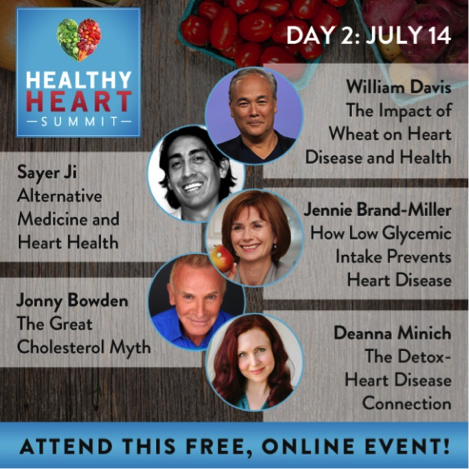
Here are the speakers for Day 2:


You can prevent most of your risk of heart disease with lifestyle changes!
Start today!

To Your Health
Dr. Barbara

Monday, June 22, 2015

Getting Your Gut Bacteria Healthy is One of the Most Important Things You Can Do to Get and Stay Healthy-Dr. Mark Hyman.


It is my opinion that one can't heal from gluten induced disorders if one doesn't look after
MRSA
and heal the microbiome, the up to four pounds of organisms that live in our bowel.

Remember, labelled gluten free processed food is allowed to have gluten in it, but even worse, processed gluten free food made up of carbohydrates, phytates, and other anti nutrients, feed pathological organisms, and makes the wrong organisms grow in the microbiome: the one's that promote inflammation throughout the body.

Having most of the microbiome composed of "good' bacteria, or ''essential" bacteria and yeasts, is important for good health. Studies have been done where the microbiome of a fat mouse is introduced to a genetically similar slender mouse and the slender mouse became obese. Hmmm!


There have been studies that have shown that the composition of the microbiome of a depressed person is different than someone who is not depressed. 

The study of our "internal garden" is the subject of much research, and I believe the future of medicine will include treatments with specific "probiotics" for specific conditions.

But for now, eating a scientifically based traditional diet - including fermented food and drinks (and sea vegetables) - that is also free of grain, sugar, and for the most part dairy,  a diet that is without chemicals, and is mostly home cooked is the way to "tend" your garden. Because it has science behind it and documented long term results with real people, I recommend the Gut And Psychology Syndrome (GAPS) program, and it's step by step proven way to get results.

See what Dr. Mark Hyman has to say about this internal "garden". In this article he restates much of the basics, which can sometimes be overwhelming, of healing and of staying healthy. And the good reasons why it is in our best interests to do so: We want to age slower and to prevent unnecessary illness whether it is brain related such as dementia, or arthritis. This is a very practical piece. Even if you just pick one way to improve your lifestyle, you will improve. 

To quote Dr. Mark Hyman:
"The food we eat not only feeds our fat cells, but also determines what kind of inner garden we are growing in our guts. This garden is filled with bugs that determine more about your health and your emotional and mental well-being than you ever imagined! Getting your gut bacteria healthy is one of the most important things you can do to get and stay healthy. If your bacteria are sick, so are you!"

Read more to learn how to tend your inner garden and be the best you can be!


To Your Health 
Dr. Barbara

Monday, March 30, 2015

A Guide to Sweeteners: Washington Post with Periodic Table

Now that you have watched Dr. Lustig's video on the impact of fructose and sugar on your metabolism, you may be interested to know more about the other varieties of sweeteners you find in packaged foods, in your food and on the shelves. You may be asking "are artificial sweeteners safe to use instead of sugar or corn syrup or fructose"?

When it comes to aspartame, saccharin, and sucralose, a recent study found that these three artificial sugar substitutes can upset the balance of intestinal flora, causing glucose intolerance in mice and it has been found to be the same in some human tests.

IT'S ABOUT THE MICROBIOME

Do we want to have the most healthy intestinal flora, sometimes called microbiome that we can get? Yes! 
Is it easy to upset that living, breathing group of living organisms in our gut when we live in the modern world where everything we eat, or drink or swallow can influence the "bugs". Again yes!

Is there an easy way to reestablish and maintain a healthy microbiome? I think yes, a specific carbohydrate diet, described in Gut and Psychology Syndrome, with clean water, and avoiding chemicals as much as possible. 

Below is a succinct chart on the sweeteners available. It reminds us that while raw honey has many good properties, including being a antibiotic for skin infections, it does have a lot of calories and fructose, and should be used sparingly. And with fat to lower its impact on glucose metabolism. In a recipe calling for honey, I tend to cut the amount in half and I find I do get a tasty product still. 

I also like maple syrup, in small amounts and stevia leaf powder

A guide to sweeteners

By Patterson Clark and Lazaro Gamio, Published: March 2, 2015

Too much sugar can be detrimental to health, rotting teeth, building fat, damaging blood vessels and stressing out the system that regulates blood sugar. Some people turn to artificial sweeteners, but those are under increasing suspicion of creating metabolic problems, such as diabetes and obesity. Natural alternative sweeteners exist, but even they have pitfalls if consumed in excess.Read related article.

Sweeteners: a periodic table
This table charts the wide variety of sweeteners available in the United States, either in bulk amounts or as additives in food. Not listed are super-sweet- tasting, zero-calorie proteins from several African fruits (monellin, brazzein and thaumatin), which have not been approved for use by the FDA. Also not included: banned or poisonous sweeteners, such as lead acetate, which ancient Romans made by cooking sour wine in lead pots.

It is tempting to try out a new sweetener that we may see at the health food store, but they really have not been tested for long term safety and so I can't recommend them. They are also frequently in combination with fructose. 

How much fructose is safe to eat? For the average person probably 10- 15 grams a day.

You may be wondering how this story is linked to the subject of brain health and gluten sensitivity. Inflammation and blood sugar imbalances are linked to mental health symptoms, neurological conditions and to gut dysbiosis. Alzheimer's, as an example, is called type 3 diabetes for a reason. 

To Your Health
Dr. Barbara


Thursday, March 26, 2015

"Sugar: The Bitter Truth"- A Must See Video by Dr. Robert Lustig from UCSF


If you want to know more about how carbohydrates including fructose found in fruits and rice cause chronic illness, watch this superb video by Dr. Lustig from University of California, San Francisco, called "Sugar: The Bitter Truth!" 

Don't drink your calories!
And Alzheimer's researchers suggest the only fruit you should eat if you want to lower your risk of Alzheimer's is berries! 

And stick to a specific carbohydrate diet, GAPS protocol, or sugar free Paleo, especially if you are gluten sensitive.
You can do it. 
To Your Health
Dr. Barbara 


Monday, March 16, 2015

Food for Thought: How Gut Microbes Change Your Mind: Jon Cryan's TedMed Talk

If you have been reading my blog for awhile, you know I link our mental health to the health of our GI system but fundamentally to the microorganisms that live there. They give off chemicals that are good for us or toxic to us. And they balance or direct our immune system. I aim my treatment protocols to the correcting the balance of the microbiome.

In my opinion the main way to have the wrong or pathological microbiome is to have low vitamin D, or a cesarean section, which triggers gluten sensitivity in about 40-50% of the population, usually unrecognized or undiagnosed. Continued ingestion of grains and dairy lead to the overgrowth of pathological bacteria, viruses, parasites, and fungus. (There are lots of other compounding environmental irritants like heavy metals like lead, infections, low intake of B vitamins in the person with methylation polymorphism or the use of antibiotics that I have already written about.) These pathological organisms cause disease! Mental and physical. And in gluten sensitive people who are eating gluten, their life expectancy is 20 years shorter or stated another way: an increased death rate of 400% by the age of 65. And it is doesn't have to be this way!

John Cryan investigates how the gut microbiome affects the mammalian brain. He is Chair of the Department of Anatomy and Neuroscience and Principal Investigator in the Alimentary Pharmabiotic Center at University College of Cork (Ireland). His research has far-reaching public health implications, from how we view Caesarean sections, to how the microbiome influences brain development, to the impact of probiotics on mood. John’s work shows that the term “gut feeling” might actually make neurobiological sense.


Please view the short 13:16 TedMed talk by neuroscientist John Cryan where he shares surprising facts and insights about how our thoughts and emotions are connected to our guts. 

And if you have time here is the short 5:28 minute video "The invisible universe of the human microbiome."

You should be asking yourself, how do I find out if I am in the high risk group for mortality or morbidity? Since there are no reliable blood tests, symptoms, or signs of celiac disease or non celiac gluten sensitivity, I suggest everyone get tested with a simple, inexpensive, and reliable test for both called "genetics" from www.enterolab.com. No needles involved!

For those of you who know you are gluten sensitive: get rid of the toxic gluten 100% of the time. And heal the microbiome with a scientifically proven, grain free, sugar free, starch free, GAPS diet


To Your Health

Dr. Barbara