Monday, June 22, 2015

Getting Your Gut Bacteria Healthy is One of the Most Important Things You Can Do to Get and Stay Healthy-Dr. Mark Hyman.


It is my opinion that one can't heal from gluten induced disorders if one doesn't look after
MRSA
and heal the microbiome, the up to four pounds of organisms that live in our bowel.

Remember, labelled gluten free processed food is allowed to have gluten in it, but even worse, processed gluten free food made up of carbohydrates, phytates, and other anti nutrients, feed pathological organisms, and makes the wrong organisms grow in the microbiome: the one's that promote inflammation throughout the body.

Having most of the microbiome composed of "good' bacteria, or ''essential" bacteria and yeasts, is important for good health. Studies have been done where the microbiome of a fat mouse is introduced to a genetically similar slender mouse and the slender mouse became obese. Hmmm!


There have been studies that have shown that the composition of the microbiome of a depressed person is different than someone who is not depressed. 

The study of our "internal garden" is the subject of much research, and I believe the future of medicine will include treatments with specific "probiotics" for specific conditions.

But for now, eating a scientifically based traditional diet - including fermented food and drinks (and sea vegetables) - that is also free of grain, sugar, and for the most part dairy,  a diet that is without chemicals, and is mostly home cooked is the way to "tend" your garden. Because it has science behind it and documented long term results with real people, I recommend the Gut And Psychology Syndrome (GAPS) program, and it's step by step proven way to get results.

See what Dr. Mark Hyman has to say about this internal "garden". In this article he restates much of the basics, which can sometimes be overwhelming, of healing and of staying healthy. And the good reasons why it is in our best interests to do so: We want to age slower and to prevent unnecessary illness whether it is brain related such as dementia, or arthritis. This is a very practical piece. Even if you just pick one way to improve your lifestyle, you will improve. 

To quote Dr. Mark Hyman:
"The food we eat not only feeds our fat cells, but also determines what kind of inner garden we are growing in our guts. This garden is filled with bugs that determine more about your health and your emotional and mental well-being than you ever imagined! Getting your gut bacteria healthy is one of the most important things you can do to get and stay healthy. If your bacteria are sick, so are you!"

Read more to learn how to tend your inner garden and be the best you can be!


To Your Health 
Dr. Barbara

Monday, March 30, 2015

A Guide to Sweeteners: Washington Post with Periodic Table

Now that you have watched Dr. Lustig's video on the impact of fructose and sugar on your metabolism, you may be interested to know more about the other varieties of sweeteners you find in packaged foods, in your food and on the shelves. You may be asking "are artificial sweeteners safe to use instead of sugar or corn syrup or fructose"?

When it comes to aspartame, saccharin, and sucralose, a recent study found that these three artificial sugar substitutes can upset the balance of intestinal flora, causing glucose intolerance in mice and it has been found to be the same in some human tests.

IT'S ABOUT THE MICROBIOME

Do we want to have the most healthy intestinal flora, sometimes called microbiome that we can get? Yes! 
Is it easy to upset that living, breathing group of living organisms in our gut when we live in the modern world where everything we eat, or drink or swallow can influence the "bugs". Again yes!

Is there an easy way to reestablish and maintain a healthy microbiome? I think yes, a specific carbohydrate diet, described in Gut and Psychology Syndrome, with clean water, and avoiding chemicals as much as possible. 

Below is a succinct chart on the sweeteners available. It reminds us that while raw honey has many good properties, including being a antibiotic for skin infections, it does have a lot of calories and fructose, and should be used sparingly. And with fat to lower its impact on glucose metabolism. In a recipe calling for honey, I tend to cut the amount in half and I find I do get a tasty product still. 

I also like maple syrup, in small amounts and stevia leaf powder

A guide to sweeteners

By Patterson Clark and Lazaro Gamio, Published: March 2, 2015

Too much sugar can be detrimental to health, rotting teeth, building fat, damaging blood vessels and stressing out the system that regulates blood sugar. Some people turn to artificial sweeteners, but those are under increasing suspicion of creating metabolic problems, such as diabetes and obesity. Natural alternative sweeteners exist, but even they have pitfalls if consumed in excess.Read related article.

Sweeteners: a periodic table
This table charts the wide variety of sweeteners available in the United States, either in bulk amounts or as additives in food. Not listed are super-sweet- tasting, zero-calorie proteins from several African fruits (monellin, brazzein and thaumatin), which have not been approved for use by the FDA. Also not included: banned or poisonous sweeteners, such as lead acetate, which ancient Romans made by cooking sour wine in lead pots.

It is tempting to try out a new sweetener that we may see at the health food store, but they really have not been tested for long term safety and so I can't recommend them. They are also frequently in combination with fructose. 

How much fructose is safe to eat? For the average person probably 10- 15 grams a day.

You may be wondering how this story is linked to the subject of brain health and gluten sensitivity. Inflammation and blood sugar imbalances are linked to mental health symptoms, neurological conditions and to gut dysbiosis. Alzheimer's, as an example, is called type 3 diabetes for a reason. 

To Your Health
Dr. Barbara


Thursday, March 26, 2015

"Sugar: The Bitter Truth"- A Must See Video by Dr. Robert Lustig from UCSF


If you want to know more about how carbohydrates including fructose found in fruits and rice cause chronic illness, watch this superb video by Dr. Lustig from University of California, San Francisco, called "Sugar: The Bitter Truth!" 

Don't drink your calories!
And Alzheimer's researchers suggest the only fruit you should eat if you want to lower your risk of Alzheimer's is berries! 

And stick to a specific carbohydrate diet, GAPS protocol, or sugar free Paleo, especially if you are gluten sensitive.
You can do it. 
To Your Health
Dr. Barbara 


Monday, March 16, 2015

Food for Thought: How Gut Microbes Change Your Mind: Jon Cryan's TedMed Talk

If you have been reading my blog for awhile, you know I link our mental health to the health of our GI system but fundamentally to the microorganisms that live there. They give off chemicals that are good for us or toxic to us. And they balance or direct our immune system. I aim my treatment protocols to the correcting the balance of the microbiome.

In my opinion the main way to have the wrong or pathological microbiome is to have low vitamin D, or a cesarean section, which triggers gluten sensitivity in about 40-50% of the population, usually unrecognized or undiagnosed. Continued ingestion of grains and dairy lead to the overgrowth of pathological bacteria, viruses, parasites, and fungus. (There are lots of other compounding environmental irritants like heavy metals like lead, infections, low intake of B vitamins in the person with methylation polymorphism or the use of antibiotics that I have already written about.) These pathological organisms cause disease! Mental and physical. And in gluten sensitive people who are eating gluten, their life expectancy is 20 years shorter or stated another way: an increased death rate of 400% by the age of 65. And it is doesn't have to be this way!

John Cryan investigates how the gut microbiome affects the mammalian brain. He is Chair of the Department of Anatomy and Neuroscience and Principal Investigator in the Alimentary Pharmabiotic Center at University College of Cork (Ireland). His research has far-reaching public health implications, from how we view Caesarean sections, to how the microbiome influences brain development, to the impact of probiotics on mood. John’s work shows that the term “gut feeling” might actually make neurobiological sense.


Please view the short 13:16 TedMed talk by neuroscientist John Cryan where he shares surprising facts and insights about how our thoughts and emotions are connected to our guts. 

And if you have time here is the short 5:28 minute video "The invisible universe of the human microbiome."

You should be asking yourself, how do I find out if I am in the high risk group for mortality or morbidity? Since there are no reliable blood tests, symptoms, or signs of celiac disease or non celiac gluten sensitivity, I suggest everyone get tested with a simple, inexpensive, and reliable test for both called "genetics" from www.enterolab.com. No needles involved!

For those of you who know you are gluten sensitive: get rid of the toxic gluten 100% of the time. And heal the microbiome with a scientifically proven, grain free, sugar free, starch free, GAPS diet


To Your Health

Dr. Barbara


Friday, March 6, 2015

Cross Contamination of Unprocessed Grains and Legumes Starts in the Field: Answer for Linda

Red Wheat
I have an answer for Linda who asked:

My question is about cross-contamination. I have been purchasing my dry goods (seeds, dried fruit, lentils, etc.) from an organic foods distributor. Their packages have a warning on the label that says "May contain nuts, soy, sesame, wheat, mustard". I have not had an issue over the past several years, but the most recent package had what appeared to be 3 wheat kernels in it. Any recommendations? Most packages I've seen have those sorts of warnings - are there organic bulk items that guarantee no cross-contamination with gluten? Thanks.


Hulless Barley
My research tells me that it would be impossible to prevent contamination of seeds, grains, lentils or other beans, even organic, with wheat or other gluten containing grains such as barley. When I asked my office assistant, who has a degree in home economics, and has been homesteading for decades, she stated the same thing that the government says about contamination. 

Contamination can occur in any stage from planting, to harvesting, to transportation, storage and finally distribution to your house or store. Wheat kernels get stuck in the crevices and seams of the combine, in the augers and semi trailers which are used to harvest other crops. The kernels come loose spontaneously and mix in with the next crop being harvested.  I suspect the contamination rate is even higher if you were to buy grains: sorghum, millet.

Spelt
I did find a study that examined the rate of contamination of oats with gluten and barley, which should reflect the contamination rate of other grains. One research group analyzed a total of 134 oat samples, collected from Europe, the United States and Canada.This study confirmed that most oats were contaminated with gluten containing grains such as barley, wheat, and rye, mostly barley. (Hernando et al. Measurement of wheat gluten and barley hordeins in contaminated oats from Europe, the United States and Canada by Sandwich R5 ELISA. Eur J Gastroenterol Hepatol. 2008 Jun;20:545-54.). I don't recommend any ingestion of oats though because they contain toxic protamines, a subject I will cover in a future blog post.  

The way I see it is you are doing the best thing to protect yourself and your family from contamination with gluten containing grains, and that is to get the non grain dry goods in their unprocessed form and organic. And then make a quick inspection for other kernels like wheat, kamut,barley or spelt that may have found its way into the the package that you bought. And remove any offending kernels that you have found. 

Buying organic is important too because of an agricultural practice ( for the last 15 years or so) of "desiccation". Desiccation uses glyphosate to improve the drying time and allows for early harvesting of many grains and legumes. This practice is quite controversial and has been implicated with the increased incidence of celiac disease and 65 other diseases.
Non organic wheat is heavily contaminated with glyphosate as are beets, lentils, sugar cane and corn. 

Find out more about the future of agriculture here where Dr. Thierry Vrain discusses GMO's.

Thank you Linda, writing and sharing. And for working so hard to keep your family well.

To Your Health
Dr. Barbara


Monday, March 2, 2015

Eliminate "Gluten Free" Products and Recover Faster Than Those Who don't-The proof!


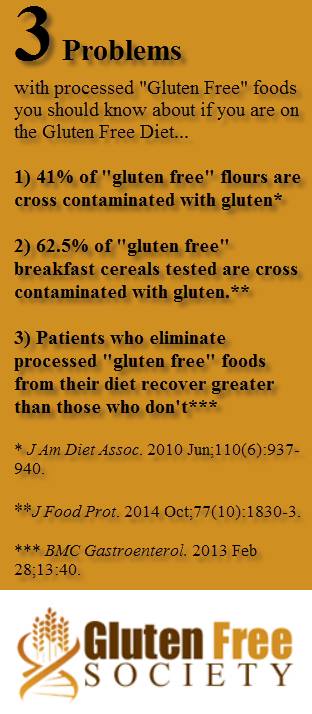
I can't recommend gluten free flours, cereals or products, even the ones labelled gluten free because I know the rate of contamination is so very high, and I know people don't get better unless they have a "true gluten free" as Dr. Osborne calls it, diet. 62.5% of gluten free cereals tested had greater than 20 mg/kg of gluten in them. Damaging amounts. Stop exposing yourself to the toxin, so your can follow up with healing.

To heal I recommend the doctor developed method called Gut and Psychology syndrome programme because it has 60 years of experience behind it, first as the specific carbohydrate diet. And because of its microbiome changing effects, which is being proven by science to be profoundly healing.


From Gluten Free Society:
More Evidence Against Processed “Gluten Free” Products

A new research study published in the Journal of Food Protection found more problems with “gluten free” products. The study looked at 78 product samples claiming to be gluten free. A summary of the study is listed below:

16 samples (20.5%) did contain gluten levels of ≥20 mg/kg, ranging from 20.3 to 60.3 mg/kg. In particular, five of eight breakfast cereal samples showed gluten contents higher than 20 mg/kg. These results may be of concern, as gluten sensitivity is known to vary among celiac disease patients.


Source: J Food Prot. 2014 Oct;77(10):1830-3.
Processed Gluten Free Products are a Potential Health Risk


What’s important to realize about this study is that the products tested were all supposed to be gluten free. 20.5% of them had enough gluten to be dangerous. 62.5% of the cereals tested contained gluten. If you are new to the gluten free diet, you most likely were told by your GI doctor or celiac support group to run out to the grocery story and start buying from the gluten free aisle.

Add this information to fact that a prior study done in 2010 showed that 41% of gluten free products tested positive for gluten.

When initially going gluten free, the average person reaches out to the gluten free aisle in the grocery store to find substitutes for pastas, breads, cereals, bagels, etc. The majority of these people seeking gluten free substitutes either remain sick or experience reduced improvement in inflammation. Some research studies show that the number is as high as 92% of patients fail to heal.

Most gluten free substitute products are made from corn, rice, and other grains (oats and sorghum) and pseudo grains (amaranth, buckwheat, quinoa). Unfortunately, these substitutes have been shown to cause damage for those with gluten sensitivity. Click the links below for some common examples:
Studies on corn gluten
Studies on certified gluten free oats
Studies on rice gluten
Studies on quinoa

Research has also shown that those following a processed gluten free diet can have a hard time healing. The study found that 81% of patients that were non responsive to a Traditional Gluten Free Diet responded to a TRUE gluten free diet (no processed foods and no grain substitutes).


I discussed much of this recently on Underground Wellness with Sean Croxton. You can listen in here <<<


To Your Health


Dr. Barbara

Monday, February 16, 2015

Complete Remission of Psychiatric Symptoms with Vitamin B12 -Case Study in Literature; It's What's In The Brain That Counts


I felt this article was well worth repeating, with some minor editing. 

Many neurological and psychiatric conditions are related to B12 deficiency. 

The rates of B12 deficiency in people with gluten sensitivity is very high. Easy to misdiagnose if you only use a serum B12 level. And it is how much B12 is in the brain that counts. 

I list a number of mechanisms for low B12:

-low stomach acid ( achlorhydria) from an autoimmune process (Gluten sensitive people have 12 times the rate of autoimmune disorders) or from drugs like metformin and proton pump inhibitors

-antibodies to the intrinsic factor producing parietal cell, lowering the amount of the protein that carries B12 from the GI system into the bloodstream- autoimmune atrophic gastritis

- dietary restrictions

- higher B12 needs because of methylation gene abnormalities called MTHFR

- and brain fluid called cerebrospinal fluid (CSF) may have a much lower level of B12 because of an impaired blood brain barrier (described by Dr. Hadjivassiliou in Lancet 2010 and caused by antibodies called Tg6) and so the brain function may be impaired.


All these factors also make it tricky to take oral B12 and expect it to increase the amount of B12 in the brain, where you want it.The blood level does not accurately reflect the level of B12 in the CSF. ( van Tiggelen CJM, Peperkamp JPC, Tertoolen JFW. Vitamin B12 levels of cerebrospinal fluid in patients with organic mental disorders. J Orthomolec Psych. 1983;12:305–311.)

I would like to report the case of a man in his early thirties who came into my practice a few months after he was admitted to a psychiatric facility for 6 weeks. After a few days of treatment, he had refused all medication, and being assess as a person with schizoaffective disorder he was discharged in much the same condition. I placed him on a gluten free diet while testing proceeded, but this was easy as he was living with his parents and his mother was on a gluten free diet already. It was difficult to get testing done but when it was done it was clear he was vitamin B12 deficient. And he had two genes for celiac disease.

He had suffered for years with mood swings, lethargy, and intermittent perceptual disturbances and had been prescribed psychotropic drugs on and off. He was never suicidal although this symptom is common in gluten sensitive individuals. (gluten sensitive teens have a 40% increased risk of dying of suicide by the age of 20, a horrible statistic.)

On the gluten free diet, he was having less negative symptoms, but there was a noticeable improvement when he self administered B12 shots. He has had periods of going off B12 shots, but his family members notice and remind him to give himself a shot. When taking shots regularly, he is alert, oriented, and has a stable romantic relationship. He is looking for work in his field.

In the literature we find a severe case where B12 was the only additional treatment. I frequently find B12 deficiency in patients with mental symptoms and neurological symptoms. For testing I use homocysteine and urinary methylmalonic acid measurements as I find serum B12 measurements unreliable and it can miss methylation polymorphisms ( which has an prevalence in my practice of 76% for at least one SNP of c677T or a1298c). I will also do a trial of IM or Subcutaneous B12, and see what happens. If people feel better after the B12 the next step is to find the frequency. Some people need a shot a day but this is unusual.( this indicates multiple methylation polymorphisms, and/or heavy metal intoxication and/or active autoimmune disorders blocking B12 from going easily through the blood brain barrier, leading to low brain levels of B12.And needing more help). I recommend folate with B12 shots to avoid folate deficiency, in the form of a good B complex, with or without NAC.

Here is what Dr. Kelly Brogan, a psychiatrist has to say about B12 and mental health:

If this is not a wake up call to the average psychiatric prescriber, I’m not sure what is. Much of what we attribute to serotonin and dopamine “deficiencies” melts away under the investigative eye of a more personalized style of medicine that seeks to identify hormonal, nutritional, and immune imbalances that can “look” psychiatric in nature.

How can B12 impact brain health?
B12 supports myelin (which allows nerve impulses to conduct) and when this vitamin is deficient, has been suspected to drive symptoms such as dementia, multiple sclerosis, impaired gait, and sensation. Clinically, B12 may be best-known for its role in red blood cell production. Deficiency states may result in pernicious anemia. But what about B12’s role in psychiatric symptoms such as depression, anxiety, fatigue, and even psychosis?


The one-carbon cycle refers to the body’s use of B vitamins as “methylators” in DNA synthesis and the management of gene expression. There are three concepts that relate to B12’s role in chronic, long-latency neuropsychiatric syndromes: 

1. Methylation
This process of marking genes for expression, like little “read me!” signs, is also critical for detox and elimination of chemicals and hormones (estrogen), building and metabolizing neurotransmitters, and producing energy and cell membranes.

2. Homocysteine recycling
B12 is a primary player in the one-carbon cycle and a co-factor for the methylation, by activated folate, of homocysteine, to recycle it back to methionine. From there, SAMe is produced, the body’s busiest methyl donor. 

3. Genetic override
Sufficient supply of an activated/bioavailable form of a vitamin (ie methylfolate vs folic acid) is even more necessary in the setting of gene variants such as transcobalamin II, MTHFR, and MTRR which may function less optimally in certain individuals and result in pathology under stress. An example of this is a report of death in a B12-deficient patient with genetic variants who underwent anesthesia with nitrous (which causes stress to the system). Notably the B12 blood level was normal, so this fatal case was attributed to functional deficiency, suggesting that access to B vitamins may not always guarantee proper utilization. For this reason, supplementing with activated forms of B vitamins enhances their likelihood of effectively supporting cellular processes.

Read her take on testing and causes of vitamin B12 deficiencies.


If you are interested in the scientific studies, see Dr. Prousky's award winning article on the rational of using B12 therapeutically for psychiatric conditions, even in the absence of "classical" deficiency.


In conclusion: if you are not feeling 100%, mentally or physically or neurologically, it could be B12.


To Your Health
Dr. Barbara